
Science reads the pixels, not the picture
Science reads the pixels with great precision. This research asks about the picture: what it means, where it comes from, and who is looking.
Modern physics has spent centuries measuring the observable properties of reality, mass, charge, wavelength, velocity, with extraordinary precision. Established This is one half of the truth.
The other half is the story the universe is telling through those properties. While science measured the screen, the narrative playing on it was left to philosophy and spirituality. This research bridges that gap. Size is the frequency of vibrating physical matter. Sight is the perception of visible light movement. Time is the measure of an event through perceived reflection of light, all constrained by the narrow range of human senses. Framework Proposition
Try it: measure the pixels
320 measurements. Shapes begin to appear, but no single pixel holds them.
- What the instrument recorded
- Tap any pixel on the screen
- Its exact value
- Waiting for a measurement
- What that value says about the picture
- Nothing yet. Measure a pixel and see.
- Pixels you have measured
- 0 of 320
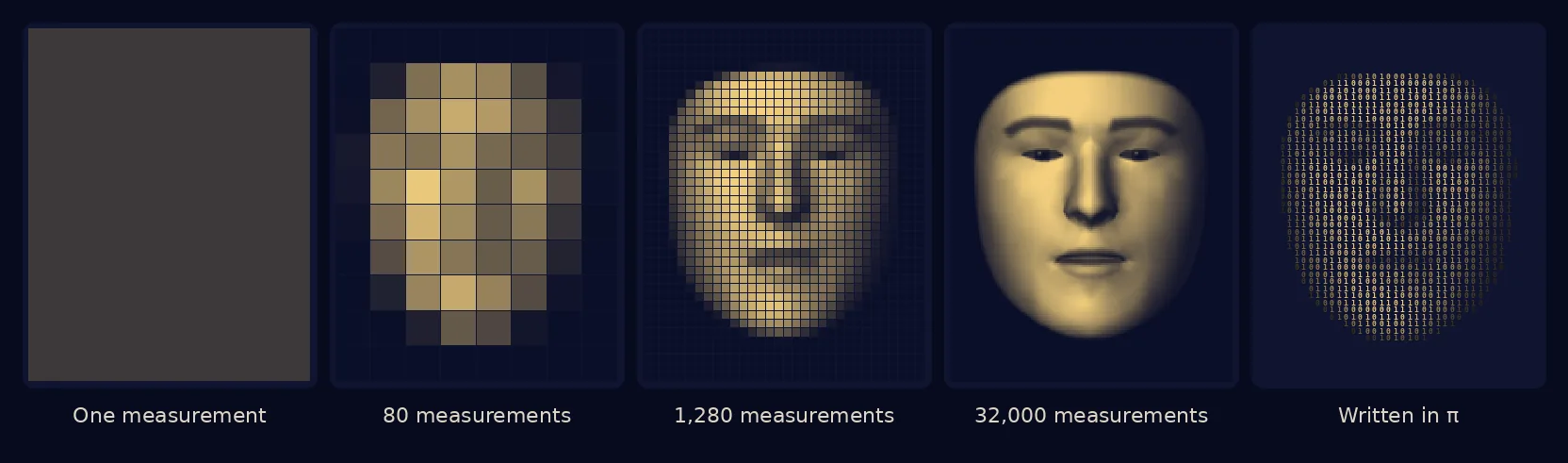
Example: open any photograph on your phone and keep zooming in. The picture disappears. What is left is a grid of tiny squares, each one a single colour. Every square can be measured exactly: its position, its brightness, its share of red, green and blue. A computer can list every value without a single mistake, and nothing in that list says “a face”, “a sunset” or “my mother”. The meaning is not stored in any one pixel. It appears only when the pixels are seen together, by someone able to see.
Science is extraordinarily good at the pixels. This research does not ask it to measure less. It asks what the measurements are a picture of.
Three walls every measurement meets
We measure only what we can reach
- Ordinary matter
- Dark matter
- Dark energy
Show the numbers as a table
| Part of the universe | Share |
|---|---|
| Ordinary matter | about 5% |
| Dark matter | about 27% |
| Dark energy | about 68% |
Ordinary matter, every star, every planet and every person, is about 5 per cent of the universe. Dark matter is about 27 per cent and dark energy about 68 per cent. Neither emits, absorbs or reflects light. We know they are there only from their pull on what we can see (Planck Collaboration, 2020). Established
We see through a narrow window
Show the bands as a table
| Band | Compared with visible light |
|---|---|
| Gamma rays | Shortest waves |
| X-rays | Shorter |
| Ultraviolet | Shorter |
| Visible light | 380 to 700 nanometres |
| Infrared | Longer |
| Microwaves | Longer |
| Radio waves | Longest waves |
The human eye detects light with wavelengths from about 380 to 700 nanometres (NASA Science). Radio waves, microwaves, infrared, ultraviolet, X-rays and gamma rays were always there. They stayed invisible until instruments were built to translate them into something we could see. Established
Measuring changes what is measured
Position fixed to within 0.10 nm. Speed uncertain by at least 579 km/s.
Show the numbers as a table
| Position fixed to within | Speed uncertain by at least |
|---|---|
| 0.05 nm | 1,158 km/s |
| 0.1 nm | 579 km/s |
| 0.2 nm | 289 km/s |
| 0.5 nm | 116 km/s |
| 1 nm | 58 km/s |
In 1927 Werner Heisenberg showed that the more precisely a particle’s position is fixed, the less precisely its momentum can be known (Heisenberg, 1927). Fix an electron to within a tenth of a nanometre, about the width of an atom, and its speed becomes uncertain by at least 579 kilometres per second. No better instrument can remove this limit. It is part of how nature is built. Established
What no instrument has recorded
Every measurement of consciousness is a measurement of a correlate: a brain state, a behaviour, a report. The experience itself never appears in the instrument. Established
The Wrong Question
There is a deeper reason. Measurement itself is an act taken by consciousness, a non-physical agent. When science asks how do we measure this, it has already assumed the answer sits in the measurable. But awareness, analysis, and observation are not products of the physical. They are prior to it. This is why materialist science, however precise, keeps arriving at the same walls at the same depths. The right questions must come before measurement, not after it. Framework Proposition
Metaphysics Is the Manifesto of Physics
“Metaphysics is the manifesto of physics. Without imagination there is no emotion. Without emotion there is no desire. Without desire there is no action. And without action, in behaviour or in the imagination of the mind, nothing is manifested in physical reality.”
Ahmed Rafik
The word metaphysics began as a title on a shelf. Long after Aristotle’s death, an editor of his works named the books that came after his Physics ta meta ta phusika, “the ones after the physical ones” (Stanford Encyclopedia of Philosophy, 2023). Established
This research reads the order the other way round. A manifesto is a declaration made before the work begins. Every building and every invention began as something that was not yet physical: an image held in the mind, a feeling about it, a wish strong enough to act on. In that sense metaphysics does not come after physics. It is the manifesto that physical reality carries out. Framework Proposition
- Imagination. Seeing with the mind’s eye uses much of the same visual machinery as seeing with the eyes (Pearson, 2019). Supported
- Emotion. Picturing unpleasant scenes raised anxiety more than thinking about the same scenes in words (Holmes and Mathews, 2005). Supported
- Desire. Anticipating a moment of strong emotion releases dopamine in the brain before the moment arrives (Salimpoor and colleagues, 2011). Supported
- Action. The chain turns inward as well as outward: action can be a movement of the body or a rehearsal in the mind. Framework Proposition
- Manifestation. Volunteers who only imagined contracting a finger muscle, five days a week for twelve weeks, became 35 per cent stronger. Those who trained physically became 53 per cent stronger (Ranganathan and colleagues, 2004). Supported
Physics studies the manifestation. This research asks where it begins. Framework Proposition
The answer in one line
Science reads the pixels with great precision. This research asks about the picture: what it means, where it comes from, and who is looking. Framework Proposition
Cite this page
Rafik, A. (2026). Science reads the pixels, not the picture [Preprint, Version 6.0]. WhatisUniverse.com. https://whatisuniverse.com/framework/science-reads-the-pixels/